My research interests lie in computational social science, applied machine learning, and experimental research. I use statistical and computational methods to investigate social, economic, and historical phenomena. Depending on the question, the work may involve constructing data, designing an experiment, training a model, building a research platform, or evaluating whether an apparent result survives repeated testing.
Computational social science
I am interested in the empirical study of institutions, markets, collective behavior, language, culture, and historical change. Computation is useful because it allows questions to be operationalized, measured, and examined across forms of data that would otherwise be difficult to analyze systematically.
Applied machine learning and AI evaluation
I train and adapt models, construct evaluation pipelines, compare meaningful baselines, and examine how results change across repeated runs and model configurations. I am especially interested in the difference between an apparent improvement and one that remains credible after controlled evaluation.
Experimental research and research engineering
I enjoy research in which the experimental system is itself a substantial part of the work. This includes translating theoretical questions into procedures, implementing the research platform, validating its behavior, and producing data that can support a defensible analysis.
Human-AI collaboration
Feb 2026 to present
Research Assistant, New York University Abu Dhabi
At New York University Abu Dhabi, I contribute to the study design of an experimental research project on human-AI collaboration and lead the technical implementation of its online research platform.
My work focuses on translating theoretical requirements into platform behavior, structured validation checks, and data workflows for subsequent empirical analysis.
Protein language models
Feb 2026 to present
Research Assistant, eBRAIN Lab, New York University Abu Dhabi
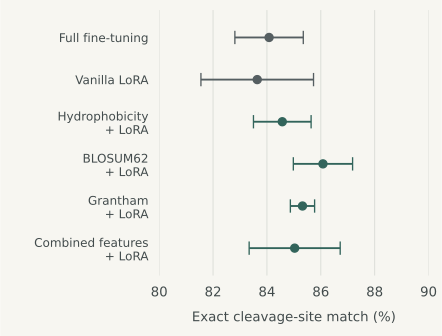
At the eBRAIN Lab, I develop and evaluate parameter-efficient methods for adapting protein language models to protein-sequence tasks.
The work focuses on constructing training and evaluation pipelines, running multi-seed experiment sweeps on the university high-performance computing cluster, and examining whether results remain stable across model configurations.
Hinglish named-entity recognition
Fall 2024
Fine-tuned mBERT and XLM-RoBERTa for named-entity recognition on Hindi-English code-mixed text from COMI-LINGUA and benchmarked them against zero-shot general-purpose language-model baselines.
Repository → Research report →