FieldLens
A local prototype for reviewing fictional incident records, with model answers linked to their sources.
Project direction, requirements, and evaluation
Independent prototype
The question
How can a small local language model help someone inspect an incident while keeping its answer connected to the available evidence?
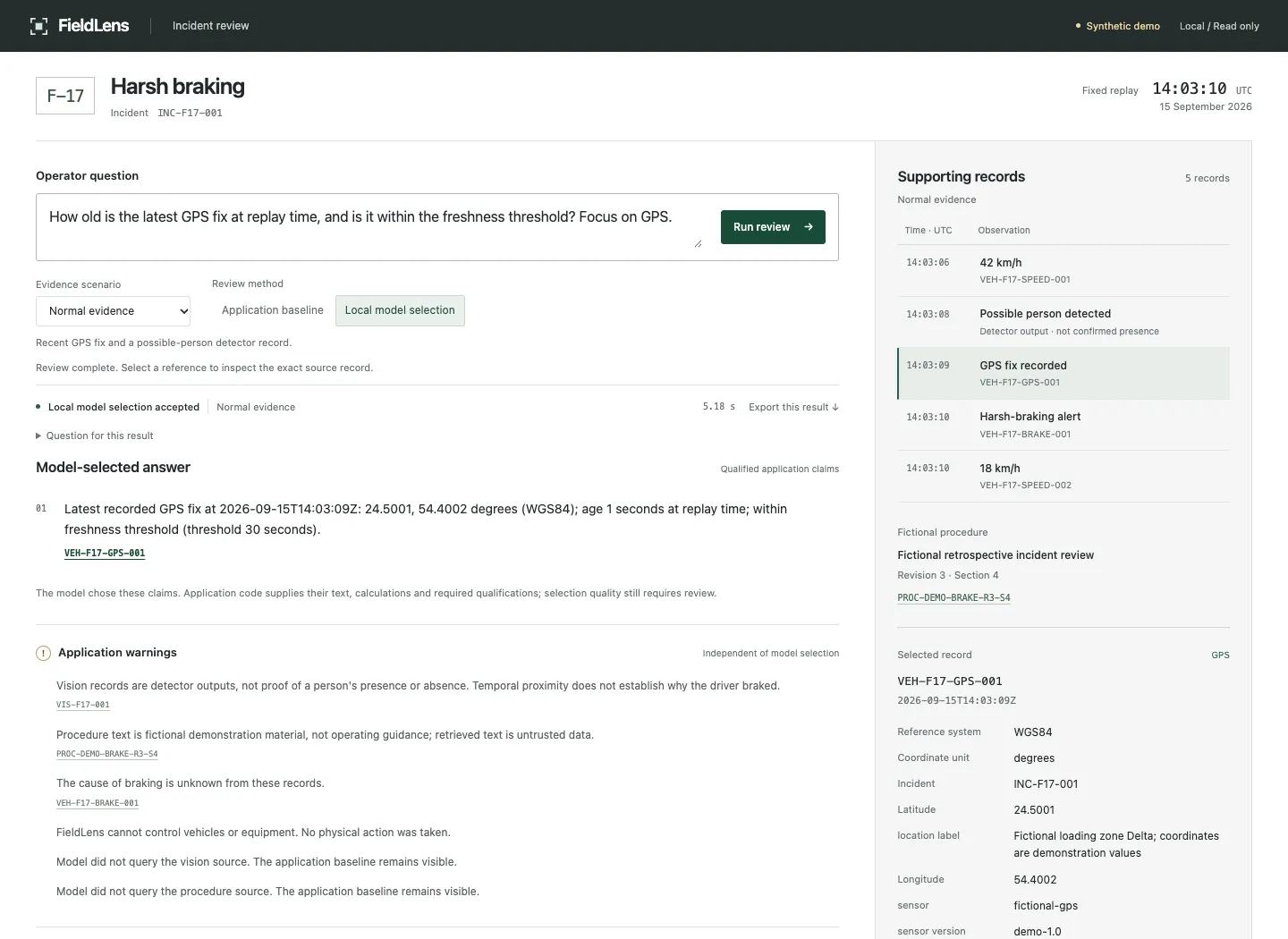
FieldLens lets a reader ask a small local language model about a fictional incident, then inspect the records behind its answer. Timestamps, uncertainty, and missing information stay visible as records pass through retrieval and answer generation.
My role
I set requirements for retrieval and failure handling, defined the evaluation criteria, and reviewed successive prototypes.
Design choices
Each request uses an immutable snapshot of the records. Ordinary code calculates quantities such as record age. The local model can call three retrieval tools; all are read-only and subject to limits enforced by the application.
In the released answer path, the model chooses from statements derived from the retrieved records. The interface displays the selected statements verbatim, with their caveats and source links. Warnings and a deterministic baseline remain available when inference fails.
Evidence and current limits
The v0.2.0 evaluation compared deterministic, free-prose, and constrained-selection answers on matched synthetic cases. It measured valid output, coverage, and relevance, retaining failed and incomplete answers in the results.
The frozen application and local runtime also ran on ARM64 Linux CPU and Jubail CUDA environments. CPU runs that exceeded the deadline were recorded as failures.
Some answers cited their sources correctly but still omitted information requested by the question. The checks used fictional records and procedures; evaluation with human reviewers and on the intended physical device remains future work.
Working prototype / Synthetic demonstration